P. N. Oak
Purushottam Nagesh Oak (2 March 1917 – 4 December 2007), commonly referred to as P. N. Oak, was an Indian writer, notable for his Hindu-centric brand of historical revisionism. Oak's "Institute for Rewriting Indian History" issued a quarterly periodical called Itihas Patrika in the 1980s.
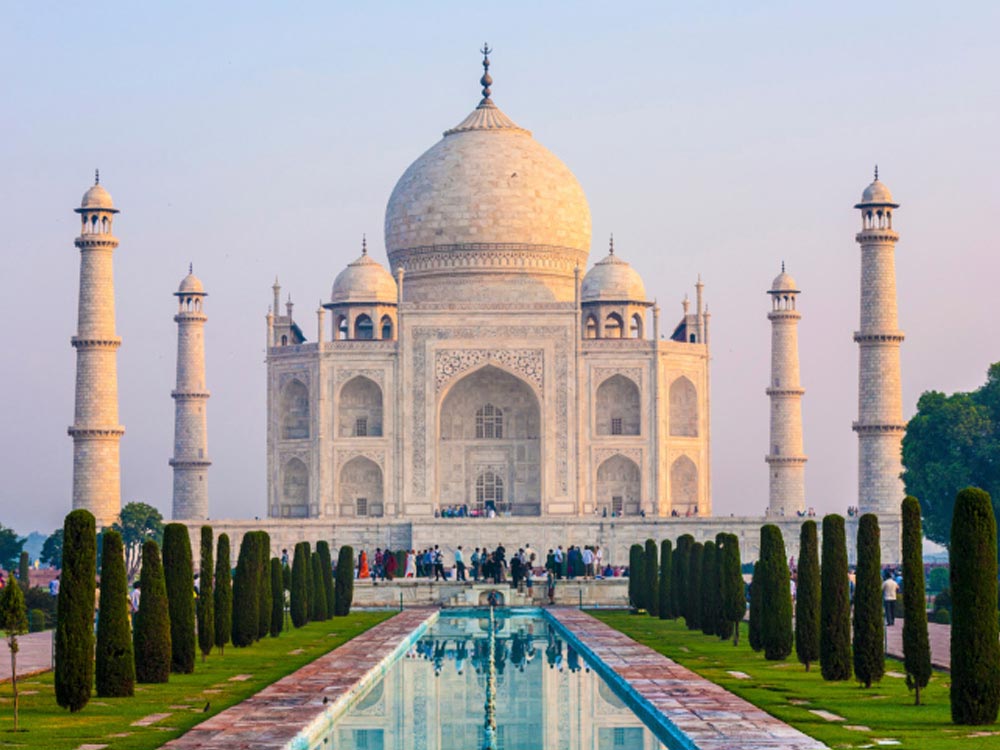
In his book Taj Mahal: The True Story, Oak claims that the Taj Mahal was originally a Shiva temple and a Rajput palace named Tejo Mahalaya seized by Shah Jahan and adopted as a tomb. He says that Mahal is a word to describe a royal palace and not a tomb and after seizure by Shah Jahan, the name was changed to Taj Mahal.[19]
The Taj, Oak says, is a "typical illustration of how all historic buildings and townships from Kashmir to Cape Comorin though of Hindu origin have been ascribed to this or that Muslim ruler or courtier".[19] He goes on to propose Hindu origins for the tombs of Humayun, Akbar and Itmiad-u-Dallah and "all historic buildings" in India as well as the Vatican,[20] the Kaaba and Stonehenge.
Further, Oak says that well known western authorities on architecture like E.B. Havell, Mrs. Kenoyer and Sir W. W. Hunter have gone on record to say that the Taj Mahal is built in the Hindu temple style.[19] Havell points out the ground plan of the ancient Hindu temple of Java, the Chandi Siva Prambanan Temple is identical with that of the Taj Mahal.[19] A central dome with cupolas at its four corners is a universal feature of Hindu temples. The four marble pillars at the plinth corners are of the Hindu style. They are used as lamp towers during night and watch towers during the day...[19] Also, he points out that the octagonal shape of the Taj Mahal has a special Hindu significance because Hindus alone have special names for the eight directions and celestial guards assigned to them.[19] Also he points out that finial of the Taj Mahal, depicts the trident pinnacle over the dome and the central shaft of the trident depicts a Kalash, holding two bent mango leaves and a coconut, which is a sacred Hindu motif.[19] Oak claims that Hindu ornaments and symbols were effaced from the Taj, whose sealed chambers hold the remnants, including a Shiva Lingam, of the original temple and that Mumtaz Mahal was not buried at her cenotaph.
In support of these claims, Oak presents carbon dating results of the wood from the riverside doorway of the Taj, quotes from European travellers' accounts and the Taj's Hindu architectural features. Oak further alleges that eyewitness accounts of the Taj Mahal's construction as well as Shah Jahan's construction orders and voluminous financial records are elaborate frauds meant to hide its Hindu origin.[19]
Oak petitioned the Indian parliament demanding that the Taj be declared a Hindu monument and that cenotaphs and sealed apartments be opened to determine whether Shivalingam or other temple remains were hidden in them.[19] According to Oak, the Indian government's refusal to allow him unfettered access amounts to a conspiracy against Hinduism. The Indian government has maintained that out of respect for the dead, unnecessary openings of cenotaphs and sealed rooms cannot be allowed.[citation needed]
Oak's denial of Islamic architecture in India has been described as one of the "more extreme manifestations of anti-Muslim sentiment" in Maharashtrian popular culture.[21] K. N. Panikkar locates Oak's work in the Hindutva movements attempt to foster a communal understanding of Indian history.[22] Tapan Raychaudhuri has referred to him as "a 'historian' much respected by the Sangh Parivar."[23]
In 2000 India's Supreme Court dismissed Oak's petition to declare that a Hindu king had built the Taj Mahal and reprimanded him for bringing the action, saying he had a "bee in his bonnet" about the Taj.[24][25] In 2005 a similar petition was dismissed by the Allahabad High Court. This case was brought by Amar Nath Mishra, a social worker and preacher who says that the Taj Mahal was built by the Hindu King Parmar Dev in 1196.[25]
Please share
Credit WIKIPEDIA


• Share •